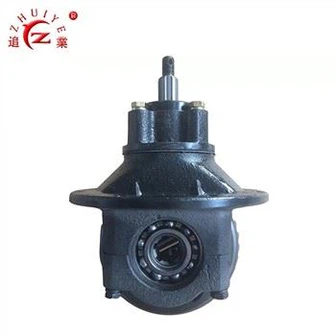
Slip Differential
In order to improve the passing ability of the car on bad roads, some off-road vehicles and high-end cars are equipped with anti-skid differentials. The characteristic of the slip differential is that when one side of the driving wheel slips on a bad road, most or even all of the torque can be transmitted to the driving wheel on a good road, so as to make full use of the adhesion of the driving wheel to generate Sufficient driving force to make the car start or continue driving smoothly. To achieve the above requirements, the easiest way is to set a differential lock on the symmetrical bevel gear differential to make it a positive locking differential. When one side of the drive wheel is slipping, the differential lock can be used to lock the differential and not act as a differential.
The anti-skid differential can overcome the common bevel gear differential caused by the even distribution of torque to the left and right wheels when driving on bad roads (muddy, icy and snowy roads, etc.) The road surface slips in place (slip), and the driving wheel on the other side on a good road is in a stationary state, which reduces the car's passing ability. This is because the adhesion between the driving wheel and the road surface in contact with the muddy, icy and snowy road is reduced, and the road surface has a small reaction torque on the half shaft. Combined with the symmetrical bevel gear differential, the torque is evenly distributed. The torque obtained by the driving wheel on the good road can only be equal to the torque of the driving wheel on the bad road, so the combined force of the two is not enough to overcome the driving resistance, and the car will stop.
According to different structural characteristics, there are three types of anti-skid differentials: positive locking type, high friction type and free wheel type. Among them, there are five types of high-friction type self-locking differential, Torsen differential, worm gear differential, slider cam differential and viscous coupling differential.
"Torson" differential is a torque-sensing differential produced by Gleason Company in the United States, that is, the differential can decide whether to limit the differential effect of the differential according to the size of its internal differential torque. The structure is cleverly designed using the irreversible principle of the turbine worm drive. As a new type of differential mechanism, Torsen differential has been widely used in various automobiles due to its unique and superior performance