Gear main parameters
Number of teeth Z
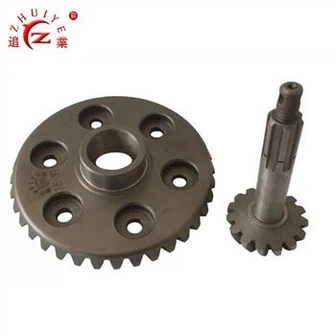
Spiral bevel gear
The closed gear transmission generally has a high speed. In order to improve the stability of the transmission and reduce the impact and vibration, it is better to have more teeth. The number of teeth of the pinion can be taken as z1=20~40. Open (semi-open) gear transmission, because the gear teeth are mainly worn out, in order to prevent the gear from being too small, it is not appropriate to use too many teeth for the pinion, generally z1=17~20.
Helix angle
β > 0 is left-handed;
β < 0 is right-handed
tooth pitch
pn=ptcosβ (the subscripts n and t represent the mark of the normal and end faces, respectively)
modulus
The modulus refers to the ratio of the tooth pitch p between the tooth profiles on the same side of two adjacent gear teeth to the pi ratio (m=p/π), in millimeters. Modulus is one of the most basic parameters of modulo gear teeth. For the moduli of spur, helical and bevel gears, please refer to the standard module series table (GB/T 1357-1987).
mn=mtcosβ
m=p/π
The index circle of the gear is the benchmark for designing and calculating the dimensions of each part of the gear, and the circumference of the index circle of the gear = πd = z p
The modulus m is a basic parameter that determines the size of the gear. The gear with the same number of teeth has a large module, and its size is also large.
pressure angle
α rb=rcosα=1/2mzcosα
At the tangent point P of the pitch circles of the two gears, the acute angle between the common normal of the two tooth profile curves (that is, the force direction of the tooth profile) and the common tangent of the two pitch circles (that is, the instantaneous direction of motion at point P) is called the acute angle. Pressure angle, also known as meshing angle. For a single gear, it is the tooth form angle. The pressure angle of the standard gear is generally 20”. In some occasions, α=14.5°, 15°, 22.50° and 25° are also used.
Dividing circle diameter
d=m*z
Center distance
a=1/2*m(z1+z2)
correct meshing conditions
m1=m2,α1=α2,β1=β2
In order to prevent the gear from undercutting, for the standard straight-edge cylindrical gear with α=20o, z1≥17 should be taken. Z2=u·z1.
Addendum height factor and tip clearance factor
—h*a, C*
When the two gears are meshed, the tooth tip of one gear always enters the tooth root of the other gear. In order to prevent thermal expansion from being dead and to have space for storing lubricating oil, the tooth root height is required to be greater than the tooth tip height. To this end, the addendum height coefficient and the headspace coefficient are introduced.
Normal tooth: h*a =1; C*=0.25 Short tooth: h*a =0.8; C*=0.3