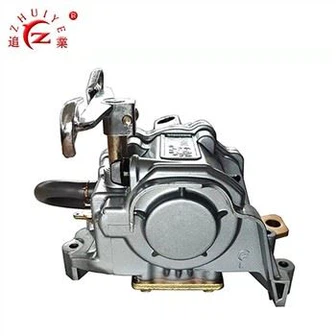
Transmission Reverse Gear Principle Transmission Introduction
There are two types of gearboxes, manual and automatic, and the components of automatic and manual gearboxes are not necessarily the same. How much do friends know about transmission oil? Let us give you a brief introduction to the principle of the gearbox.
Introduction to Gearbox: Principle
The key to a manual transmission consists of gears and shafts through which speed and torque can be varied through different gear combinations. Automatic transmission AT is composed of hydraulic torque converter, planetary gear and hydraulic control system, through the combination of hydraulic transmission and gears to achieve variable speed and torque.
Among them, the hydraulic torque converter is the most characteristic part of AT, which is composed of pump wheel, turbine wheel and guide wheel, and directly inputs the engine power to transmit torque and clutch. The pump wheel and the turbine are a pair of working combinations, just like two fans placed at the same time. The wind from one active fan will drive the blades of the other passive fan to rotate, and the flowing air will become the medium of kinetic energy transmission.
Introduction to the reverse gear principle of gearbox: intermediate shaft
There are six gears on the countershaft which operate as a unit. The front gear meshes with the shaft constant mesh gear, called the countershaft constant mesh gear. Power input to the shaft from the clutch is transmitted through this pair of constant mesh gears to the gears on the countershaft. Each gear is called the third gear, second gear, reverse gear, first gear and fifth gear of the intermediate shaft in turn.
Brief introduction to the reverse gear principle of the gearbox: transmission connection.
The second shaft is on the second shaft, and the three spline hubs are fixedly installed through splines, and the gears of the second shaft are installed through bearings. From front to rear, the third and second gears are installed between the first and second splined hubs, and the first and fifth gears are installed between the second and third splined hubs. gears meshing. Connecting sleeves with internal splines are respectively sleeved on the three spline hubs, and a synchronous mechanism is provided. By moving the joint sleeve back and forth, the splined hub can be connected with the joint ring gear on the adjacent gear, and the power on the gear can be transmitted to the second shaft. Wherein the second joint sleeve is also provided with a reverse gear. The front end of the second shaft is inserted into the central hole of the shaft gear, and a needle bearing is arranged between the two. The rear end of the second shaft is connected with the universal transmission through a flange.