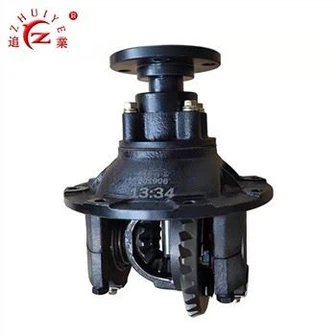
Differential Principle
This adjustment of the differential is automatic and involves the "principle of least energy consumption", that is, all objects on earth tend to consume the least energy. For example, put a bean into a bowl, the bean will automatically stay at the bottom of the bowl and never stay on the wall of the bowl, because the bottom of the bowl is the position with the lowest energy (potential energy), it automatically chooses rest (minimum kinetic energy) instead of will keep moving. In the same way, the wheels will automatically tend to the state with the lowest energy consumption when turning, and automatically adjust the rotation speed of the left and right wheels according to the turning radius. [2]
When turning, due to the phenomenon of slippage of the outer wheel and the phenomenon of slippage of the inner wheel, the two driving wheels will generate additional forces in opposite directions at this time. Due to the "minimum energy consumption principle", the wheels on both sides will inevitably be The rotation speed of the two is different, which destroys the balance relationship between the three, and is reflected on the side gear through the half shaft, forcing the planetary gear to rotate, so that the speed of the inner half shaft is slowed down, and the speed of the outer half shaft is accelerated, so as to realize the speed of the wheels on both sides. difference.
If the drive wheels on both sides of the drive axle are rigidly connected by a whole shaft, the two wheels can only rotate at the same angle. In this way, when the car turns to drive, since the outer wheel moves a greater distance than the inner wheel, the outer wheel will produce slippage while rolling, and the inner wheel will produce slippage while rolling. Even if the car is driving in a straight line, the wheels will slide due to uneven road surface or uneven tire rolling radius (tire manufacturing error, different wear, uneven load or uneven air pressure).
Wheel slip not only increases tire wear, increases power and fuel consumption, but also makes steering difficult and braking performance worse. In order to prevent the wheels from slipping as much as possible, the structure must ensure that the wheels can rotate at different angles.
Between axles: Usually the driven wheels are supported on the main shaft with bearings so that they can rotate at any angle, while the driving wheels are rigidly connected to the two half-shafts, respectively, and a differential is installed between the two half-shafts. This differential is also known as an inter-axle differential.
For multi-axle-driven off-road vehicles, in order to enable each drive axle to rotate at different angular speeds to eliminate the slippage of the drive wheels on each axle, some are equipped with an inter-axle differential between the two drive axles.